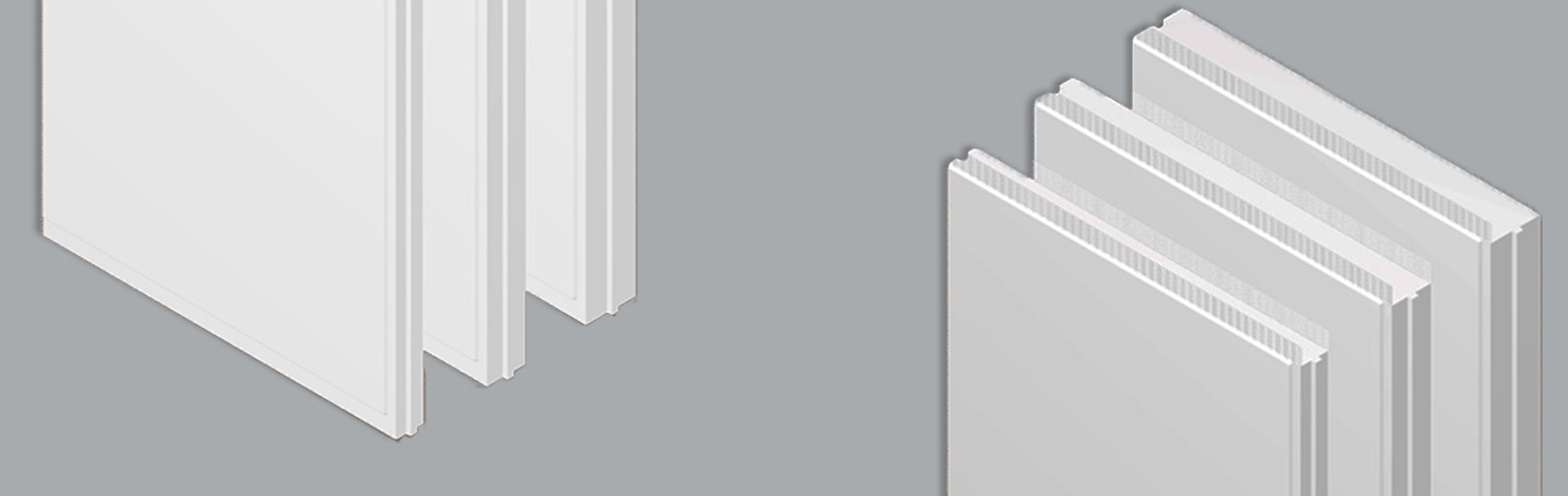
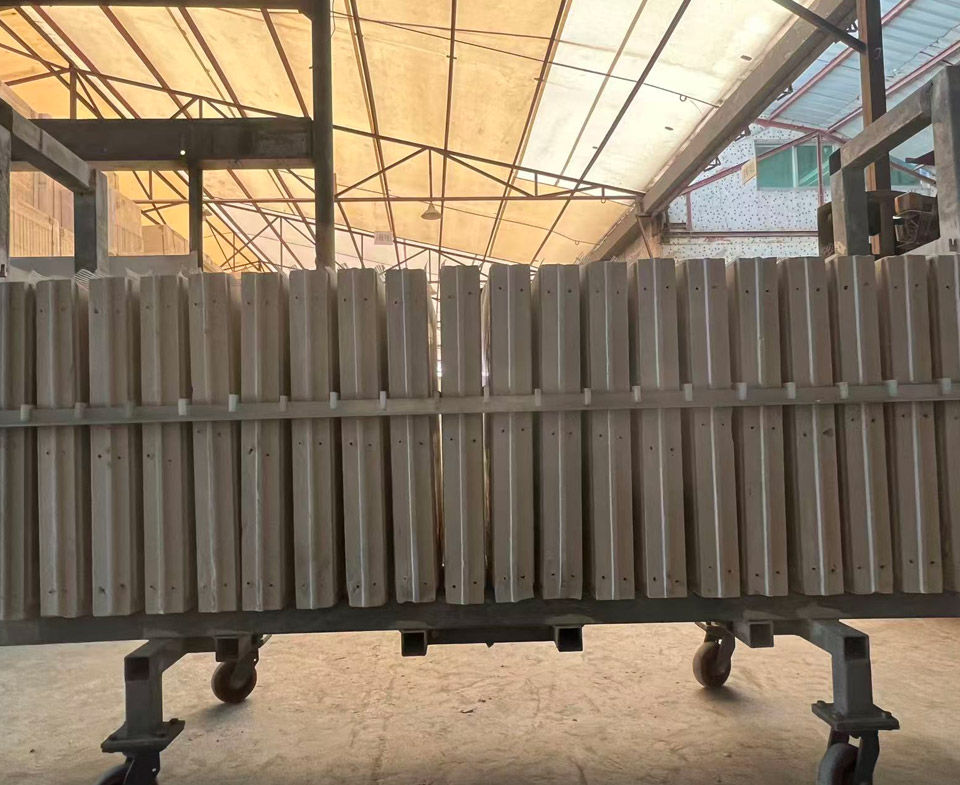
R-Panel (Known as Reconstruct-able Laminated Wall Panel) is based on the concept of a tensioned fabric roof system in taking high tensile load under a large span and extreme light weight. The idea is to develop a fabric wall system so that it has a tensioned fabric working inside as wall structure. The wall system is made from gypsum, synthetic mesh fabric, rock-wool, perlite, or polystyrene internal core with suitable additives and water (depending on the Model type). It is composed of at least two meshes in-built gypsum panels with mesh extended beyond the panel from at least two adjacent edges, while the centre is made up of rock-wool, perlite, or polystyrene infill in between alternate layers of gypsum panels for a multiple-layer model. Its major characteristic relies on its in-built mesh fabric extended beyond the panel edges from at least two sides, which has ensured the achievement of a seamless, continuous wall panel, even though the system is made up of multiple pieces. Therefore, the R-Panel system maintains its unique characteristics of impact-resistant, seismic-resistant, carrying load at any point on all wall surfaces, even at panel joint locations, and behaves like one intact wall panel with easy construction. The panel itself has met the British Standard of BS5234 Part 2 in heavy-duty standard. The water-repelling R-Panel is suitable for internal and external sheathing applications with protection under a water barrier and weathering coating. The R-Panel is a new environmental friendly 4 “R” product.
If R-Panel is used to replace the traditional block wall, besides the low carbon emissions of the raw material itself, it reduces the use of steel reinforcing bar and concrete volume on the supporting structure, which would help to cut down the carbon release as well as the tonnage of site garbage. R-Panel becomes the least carbon-releasing and environmental friendly partition system.
Recycle – Gypsum is used for the manufacture of R-Panel. Gypsum is a recyclable material and can be fabricated from FGD gypsum waste by-product.
Reuse – Demolished R-Panel wall can be cut into regular pieces and reused for the reconstruction of a new wall as required. This is how the name of the product is called.
Reduce – The use of material for panel fabrication is reduced to the least required for functional partition as desired.
Replace – R-Panel is used as a better replacement for traditional high-energy-consuming products like brick, concrete block, gypsum block, AAC block, or even gypsum board wall in high load-carrying capacity.
Importantly, R-Panel has been adopted in Modular Integrated Construction (MiC) for both interior walls, external furring walls, and 1-hour floor slabs. In this application, R-Panel reduces conventional MiC weight from 23–27 tons to approximately 4 tons, significantly lowering structural demands on steel supports and foundations. A showroom showcasing R-Panel is now open at the MiC Display Centre in CIC – Zero Carbon Park, Kowloon Bay, Hong Kong.
1. Lightweight
R‑Panel weighs only 30–60 kg/m2, significantly reducing foundation and structural costs. Compared with conventional lightweight concrete/cement blocks, R‑Panel is over 40% lighter by weight.
2. Superior Sound Insulation
With tongue‑and‑groove joints and specialized core materials, R‑Panel system delivers excellent acoustic performance. Sound insulation tests showed that a 100 mm thick R-Panel wall achieves a 40 dB sound reduction, while a double-layer 140 mm thick R-Panel wall reaches 56 dB. Its unique cavity design ensures soundproofing far beyond traditional brick walls, meeting national residential standards.
3. Fire Resistance
Gypsum is naturally non‑combustible, and with the addition of fire‑retardant materials in the core, R‑panel offers outstanding protection against flames. When exposed to fire, the chemically bound water within the gypsum is released, absorbing large amounts of heat and slowing the rise of ambient temperature. This unique property ensures that R‑panel delivers reliable fire‑resistant performance. Certification by an accredited laboratory under the HOKLAS Scheme confirms that the LS100PE of the R‑panel wall system achieves a fire‑resistance rating of up to 4 hours.
4. High Load‑Bearing Capacity
Reinforced with fiberglass mesh, R‑Panel distributes tensile strength across the entire wall. Even at joints, it can securely support household fixtures. With proper hooks and anchors, single‑point loads of at least 50 kg are achievable.
5. Impact Resistance
The extended internal mesh design bridges adjacent panels, forming a unified structure. External forces are dispersed through the fiber network, giving the wall exceptional resistance to heavy impacts.
6. Thermal Insulation & Comfort
Gypsum’s porous nature minimizes heat transfer and regulates indoor humidity with seasonal changes. This creates a stable, comfortable living environment aligned with modern eco‑housing trends.
7. Slim Profile, More Space
An 80 mm R‑Panel wall increases usable floor area compared to conventional walls.
8. Easy Installation & Decoration
Smooth panel surfaces and seamless tongue‑and‑groove joints allow direct finishing. R‑Panel wall can be nailed, planed, sawn, or glued, and panels are easily cut with standard tools. Only two workers are needed for installation, greatly improving efficiency for both interior and exterior applications.
9. Seismic Resistant
Lightweight yet reinforced, the R‑Panel system remains stable without collapsing unless structural beams are pulled down. Even in severe seismic events, connected panels provide additional survival space.
10. Moisture & Water Resistance
The panel’s porous yet well-distributed structure allows it to absorb excess moisture and release it when the air is dry, helping to regulate indoor humidity for greater comfort.
11. Excellent Thermal Expansion Control
The R‑Panel system maintains dimensional stability under temperature changes, reducing risks of cracking or deformation.
12. Green & Sustainable
Made from natural gypsum, R‑Panel is low‑energy consumption, non‑toxic, odourless, and free from harmful radiation. As a recognised green building material, it fully supports sustainable development and circular economy principles.